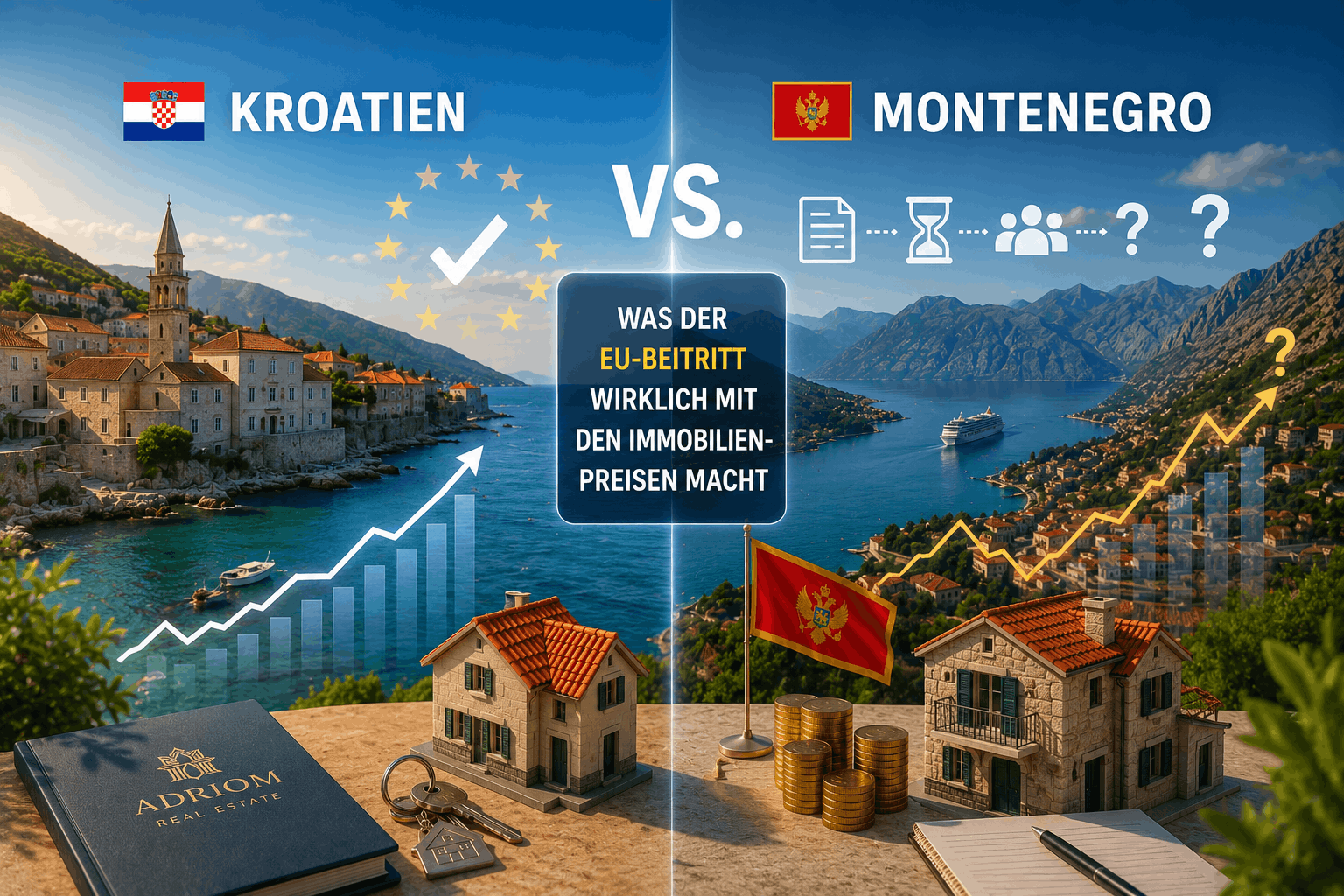
The Price Gap That Tells the Story
Before anything else, look at where prices stand today.
| Location |
Average Price per sqm (2026) |
| Dubrovnik (HR) |
€4,700–6,900+ |
| Split (HR) |
€3,000–4,000 |
| Hvar island (HR) |
€6,220 |
| Opatija (HR) |
€5,340 |
| Croatia national average |
~€2,900 |
| Tivat / Kotor Bay (MNE) |
€2,400–2,500 |
| Budva coast (MNE) |
€2,200–2,600 |
| Montenegro coastal average |
~€2,458 |
| Bar / Dobra Voda (MNE) |
€1,400–1,900 |
The comparable Adriatic coastal strip — similar climate, similar landscape, similar tourism profile — is currently priced 20–100% higher on the Croatian side. The primary structural difference between these two coastlines today is a piece of EU membership paperwork. That gap is the investment thesis in a single table.
What Happened to Croatian Prices: The Full Timeline
The story is not a straight line upward. Understanding the complete arc matters.
Phase 1: Pre-Accession Boom (2005–2008)
As Croatia's EU candidacy became credible, foreign buyers — particularly from Germany, Austria, and the UK — accelerated purchases. Coastal prices rose sharply. International demand outpaced supply in Dalmatia.
Phase 2: The Crash and the Long Bottom (2008–2015)
The global financial crisis hit hard. Croatia's property index declined from its 2008 peak through 2015, with annual price drops of around 6% in 2012, nearly 2% in 2013, and further softening through 2015. EU membership arrived in 2013 — and prices kept falling for two more years. This is the part optimists omit.
Phase 3: Steady Recovery (2015–2019)
EU membership created institutional stability, attracted structural funds, and improved Croatia's credit rating. Tourism numbers grew. Prices recovered gradually, particularly in coastal regions.
Phase 4: Post-COVID Surge (2020–2022)
The pandemic triggered a wave of lifestyle-driven demand from northern Europeans seeking second homes. Remote work changed buyer profiles. Coastal prices surged 17% in 2022 alone.
Phase 5: Eurozone Entry as Second Catalyst (2023–present)
Croatia joined the euro on 1 January 2023. This removed currency risk entirely for European buyers. The result: a fresh wave of appreciation. By Q4 2025, Croatia recorded 16.1% annual house price growth — among the highest in the entire EU. The BIS residential property price index for Croatia stood at 208 (base: 2010 = 100) as of Q3 2025, meaning prices more than doubled from 2010 levels.
The critical lesson: EU accession is not a single event that triggers a one-time price spike. It is the beginning of a multi-decade process of institutional convergence, credit rating upgrades, and deepening foreign demand — with the Eurozone entry as a second, equally significant catalyst.
Where Montenegro Is in This Sequence
Croatia in 2005–2008 is arguably where Montenegro is today — but with one important difference: Montenegro already uses the euro. It adopted it unilaterally in 2002, which means there is no currency risk for European buyers today, and there will be no Eurozone entry catalyst later. That second catalyst is already built into the current situation.
The accession catalyst itself is still ahead. As of mid-2026:
- 12 of 33 negotiating chapters have been provisionally closed
- The drafting of Montenegro's EU Accession Treaty has begun
- Prime Minister Spajić has stated 2028 as the target accession year
- Montenegro's coastal properties have risen roughly 20–23% year-on-year through 2024–2025
The market is already pricing in some of the accession premium. It has not yet priced in all of it.
The Discount: How Much Is Left?
Running the comparison on a like-for-like coastal basis:
| Metric |
Croatia (Split) |
Montenegro (Kotor/Tivat) |
Gap |
| Price per sqm |
€3,000–4,000 |
€2,400–2,500 |
20–60% cheaper |
| Rental yield (gross) |
~3.6–4.5% |
~4.4–7.1% |
Higher in MNE |
| Annual property tax |
moderate |
0.1–1% cadastral |
Lower in MNE |
| EU membership |
✅ Since 2013 |
⏳ Target 2028 |
Risk premium |
| Euro currency |
✅ Since 2023 |
✅ Since 2002 |
Equal |
Montenegro offers higher yields, lower holding costs, and meaningfully lower entry prices on a comparable coastal stretch. The premium paid for Croatia reflects a decade of EU membership, Schengen access, and Eurozone stability — all of which Montenegro is in the process of acquiring.
What the Croatia Precedent Tells Buyers to Watch For
1. The crash can come before accession
Croatia's 2008–2015 correction happened partly during the accession process. External macro shocks — a global recession, a credit crisis — can override local fundamentals. Buyers who purchased at the 2007 peak waited 10–15 years to recover in real terms.
Implication for Montenegro: The accession premium is real, but it does not protect against global macro risk. Buying with leverage in a late cycle carries risk regardless of the EU narrative.
2. The slow burn matters more than the announcement
The announcement of EU membership date generated modest immediate price movement in Croatia. The compounding effects over 5–10 years — better credit ratings, institutional reform, deeper tourism infrastructure — drove the structural appreciation.
Implication for Montenegro: The 2028 accession date is less important than what happens to Montenegro's institutions, rule of law ratings, and infrastructure between now and then. Progress on these dimensions is what drives real value.
3. Location divergence is extreme
In Croatia, Dubrovnik commands €4,700–6,900 per sqm. Slavonia (inland) sits at €800–1,500 per sqm. EU membership lifted coastal, tourism-driven markets dramatically — and did almost nothing for peripheral inland areas.
Implication for Montenegro: The accession premium will not lift all property equally. Coastal, tourism-accessible locations with strong rental fundamentals benefit. Remote or inland properties with no tourism infrastructure do not.
4. New builds outperform resales
In both Croatia and Montenegro, new construction in prime coastal locations has appreciated faster and held value better than older, unlegalised, or poorly maintained stock.
Implication for Montenegro: Quality new-build projects in established coastal zones are the rational choice for capturing the accession premium. Buying unlegalised or legally uncertain properties because they are cheap is how buyers end up stuck.
The Numbers That Matter for a Montenegro Buyer in 2026
A buyer purchasing a €150,000 apartment in Dobra Voda or Kotor Bay today with 0% developer financing over 5 years is effectively:
- Paying today's pre-accession price
- Deferring much of the cash outlay until 2028–2031
- Holding an asset that — if the Croatia pattern repeats — could be priced 30–60% higher by the time all payments are complete
- Generating rental income throughout the holding period
The downside scenario: accession is delayed, the global economy deteriorates, and prices stagnate for 3–5 years. In that scenario, a 0% financing structure still costs nothing extra in interest. The risk-adjusted math favours entry now over waiting.
The Honest Comparison: Montenegro Is Not Croatia
Two differences deserve explicit acknowledgement.
Montenegro is smaller and less liquid. Croatia's population is around 4 million; Montenegro's is 620,000. The domestic buyer base is limited. Exit liquidity in a downturn is genuinely constrained in ways that Croatia's market — especially in tourist hubs with 20+ million visitors per year — is not.
Institutional reform is further behind. Croatia had serious rule of law and anti-corruption challenges before accession — and still does. Montenegro's challenges are comparable. The reform trajectory matters more than the political declarations.
For buyers who understand these constraints and invest in high-quality, legally clean coastal property with genuine tourism demand, the Croatia comparison supports a patient, long-term case. For buyers expecting a quick flip or assuming a smooth, uninterrupted price trajectory, the Croatian precedent is a warning, not a guarantee.
What ADRIOM Offers
We work exclusively with legally verified objects — cadastral registration, building permits, and developer credentials checked before any listing.
Current projects with developer financing and coastal fundamentals:
- Bellevue Residence – Dobra Voda (Bar Region) – sea view, new build
- Bečići Apartments – Budva Riviera – beachfront
- Hladna Uvala – Utjeha/Bar – hillside coastal position
Arrange a market consultation:
info@adriom.me · +382 68 752 559 · adriom.me
ADRIOM DOO · Zubački put b.b., 85000 Bar, Montenegro
Disclaimer: This article is for informational purposes only and does not constitute financial or legal advice. Past market performance does not guarantee future results. Independent legal and financial due diligence is essential before any property purchase.