What is happening, and when
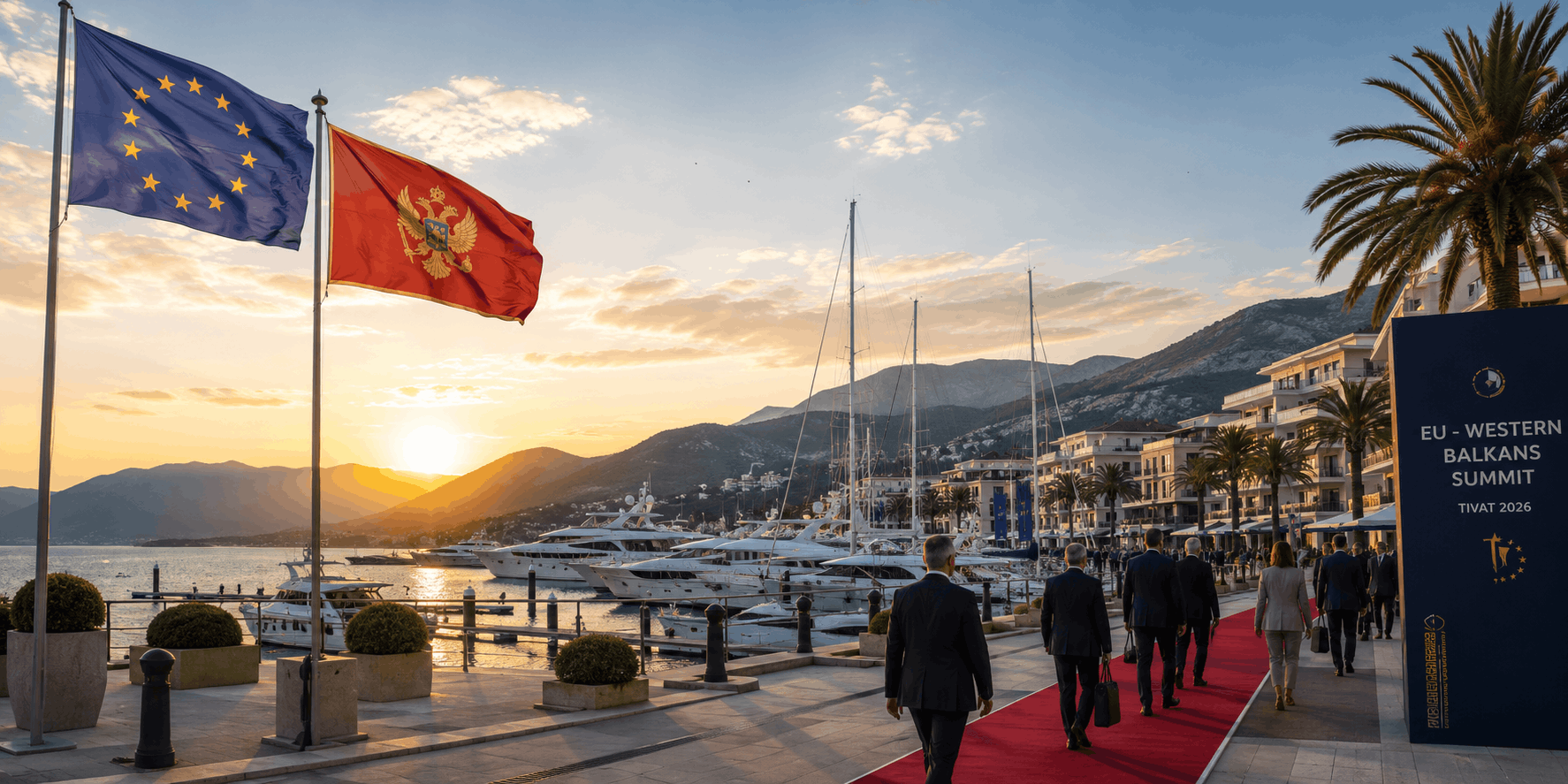
The EU–Western Balkans Summit takes place on 5 June in Tivat, at Porto Montenegro on the Bay of Kotor — the first meeting of this rank ever held in the country. It is preceded on 4 June by a ceremonial dinner marking the 20th anniversary of Montenegro's restored independence. Around 42 delegations and roughly 300 media representatives are expected.
The guest list is unusually heavy. Confirmed attendees include European Council President António Costa, Commission President Ursula von der Leyen, Parliament President Roberta Metsola, and High Representative Kaja Kallas — alongside heads of government including France's Emmanuel Macron, Germany's Friedrich Merz, Italy's Giorgia Meloni, Denmark's Mette Frederiksen, and Spain's Pedro Sánchez.
The summit's central theme is the shared prosperity and stability of the EU and the Western Balkans. Two formal sessions are scheduled: a plenary meeting and a working lunch.
Why this summit is different
For two decades, "enlargement" was a dormant file in Brussels. The war in Ukraine, the accession of Ukraine and Moldova on 1 January 2026, and the contest for influence in the region have revived it. Montenegro — the smallest candidate, with the cleanest track record — is now positioned as the bloc's frontrunner.
The numbers behind the optimism:
- 14 of 33 negotiating chapters provisionally closed as of March 2026, the most of any candidate.
- Positive IBAR (Chapters 23 & 24 — rule of law) already secured, the key that unlocks closing the rest.
- Ad Hoc Working Party on the Accession Treaty endorsed by EU ambassadors on 22 April 2026 — the procedural signal that the process has entered its final, treaty-drafting phase.
- Government target: close all remaining chapters by end-2026, accede by 2028.
One concrete deliverable expected from the summit itself is authorisation to negotiate "Roam Like at Home" agreements, extending no-roaming-charge mobile coverage between the EU and the region — a small but tangible integration step ahead of full membership.
What it means for the property market
Montenegro is following the pattern Croatia traced before its 2013 accession: a candidate on a credible final approach tends to see capital arrive ahead of membership, not after it. The investment logic is straightforward — buyers price in the convergence before it is formalised, when entry prices are still pre-EU.
The current setting reinforces this:
- Residency by investment remains available at a €200,000 property threshold (updated late 2025).
- A favourable tax regime and a euro-denominated economy (Montenegro has used the euro since 2002) remove currency risk for Western European buyers.
- The transfer-tax structure moved to a progressive scale in 2024, which rewards careful structuring on higher-value acquisitions.
The honest risk picture
Credible analysis requires naming what could go wrong — buyers from German-speaking markets in particular reward this candour:
- 2028 is the official target date. Commissioner Kos and the Commission have been explicit: without a substantial acceleration of rule-of-law reforms — judicial independence, pending institutional appointments, visa-policy alignment — closing all chapters by end-2026 will slip.
- Politics can stall the file. Montenegro's past delays were driven by domestic polarisation, not by Brussels. That risk has not disappeared.
- Accession prices in slowly, then suddenly. Appreciation tied to EU convergence is neither linear nor uniform across regions and segments. Coastal scarcity behaves differently from inland stock.
A summit does not move closing dates by itself. What it does is concentrate political capital, media attention, and investor sentiment on Montenegro at a single moment — and that attention has a measurable half-life in the months that follow.
The bottom line
For an international buyer, the relevant question is not whether Montenegro joins the EU in 2028 exactly. It is whether the country remains on a credible accession path long enough for early entry to convert into a pricing advantage. This week in Tivat, 42 delegations are betting that it does.
Considering Montenegrin property ahead of EU accession?
ADRIOM is a licensed real estate agency based in Bar, with curated coastal and mountain portfolios for international buyers across the Budva Riviera, Bar, Tivat, Kotor, Herceg Novi and the Durmitor mountains. We work with German-, Russian- and English-speaking clients and disclose the full legal and encumbrance picture on every listing before you commit.
Montenegro: +382 68 752 559 · info@adriom.me · adriom.me · adriatichomes.me
Germany (Prime Realty): +49 711 252 55 610 · info@prime-realty.de
This article is informational and does not constitute investment or legal advice. EU accession timelines are subject to political and procedural conditions and may change.